
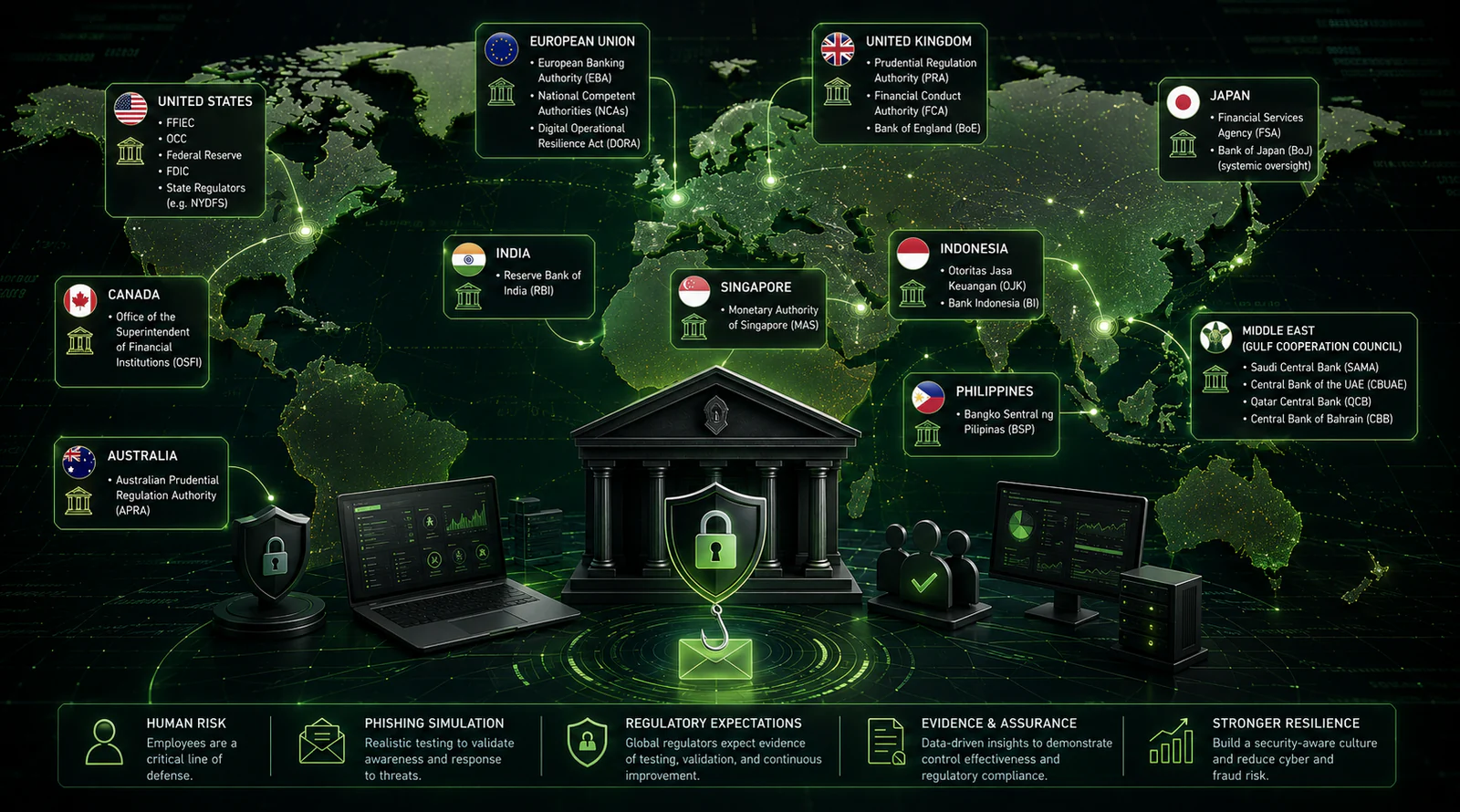
Global banking regulatory expectations related to phishing simulation
Country-specific banking regulators and how their supervisory guidance translates into explicit or implicit expectations for phishing simulation, social engineering testing, and human risk validation
In this article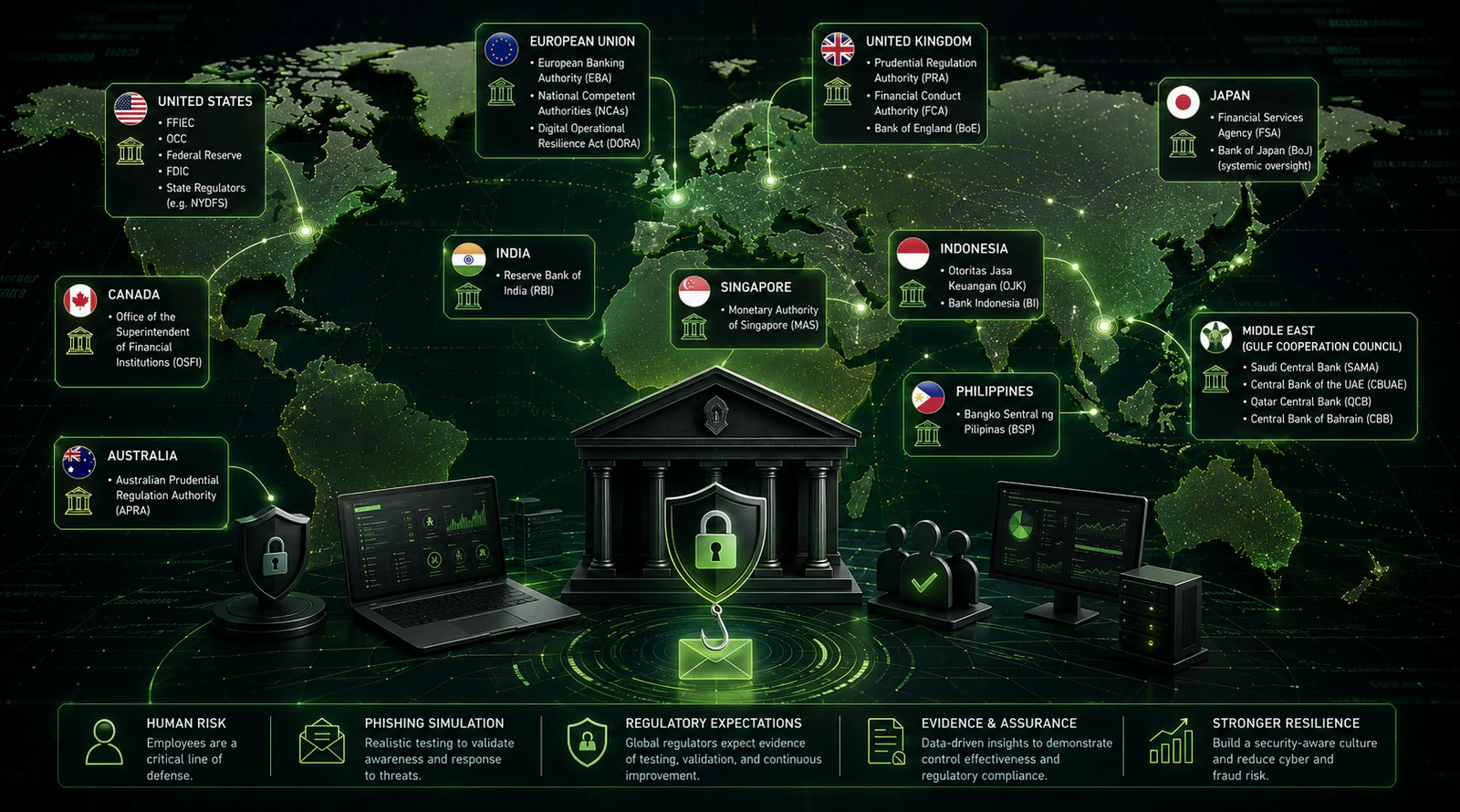
This blog lists country specific banking regulators and explains how their supervisory guidance, regulations, or examination practices translate into explicit or implicit expectations for phishing simulation, social engineering testing, and human risk validation.
While terminology varies, regulators across regions converge on one principle: banks must demonstrate through evidence that employees and processes respond effectively to realistic phishing and impersonation threats.
Note: This blog provides interpretive, high level guidance and does not replace official regulatory texts. Banks should always assess requirements in the context of their local regulator and risk profile.United States
Federal Financial Institutions Examination Council (FFIEC)
Office of the Comptroller of the Currency (OCC)
Federal Reserve
Federal Financial Institutions Examination Council (FFIEC)
State regulators (e.g., NYDFS)
US banking regulators do not mandate a single phishing testing methodology, but examination guidance consistently evaluates whether banks test employee response to social engineering threats, validate authentication and access controls in practice, and assess effectiveness beyond annual awareness training. During examinations, phishing simulation and social engineering exercises are widely accepted as evidence of human control validation
Singapore
Monetary Authority of Singapore (MAS)MAS’s Technology Risk Management guidelines require financial institutions to maintain strong cyber hygiene, staff awareness, and ongoing testing of controls. Banks are expected to demonstrate through practical exercises that employees can recognize phishing, validate requests, and follow escalation procedures. Phishing simulation is commonly used as controlled evidence of this capability
India
Reserve Bank of India (RBI)The RBI’s cybersecurity frameworks and digital payments guidance require banks to address phishing, fraud, and social engineering as key operational risks. Supervisory reviews increasingly examine whether banks conduct preparedness exercises, test controls related to payment authorization and credential protection, and demonstrate learning from simulations. Phishing simulation is widely used to evidence readiness against authorized push payment fraud and impersonation attacks
European Union
European Banking Authority (EBA)
National Competent Authorities (NCAs) of EU member states
Digital Operational Resilience Act (DORA)
The EBA’s ICT and security risk management guidelines and DORA require banks to conduct scenario based testing of operational resilience, including cyber and ICT driven threats. These frameworks explicitly expect regular testing of control effectiveness, inclusion of human behaviour and error in risk scenarios, and evidence based assurance, not policy statements alone. Phishing and social engineering attacks are treated as credible ICT risk scenarios.
United Kingdom
Prudential Regulation Authority (PRA)
Financial Conduct Authority (FCA)
Bank of England (BoE)
UK regulators frame phishing resilience under operational resilience. Banks must identify important business services and demonstrate through severe but plausible scenario testing that they can remain within defined impact tolerances. Cyber and social engineering attacks, including impersonation and fraud, are explicitly recognized as disruption scenarios that must be tested. Phishing simulations are commonly used to support operational resilience self assessments.
Canada
Office of the Superintendent of Financial Institutions (OSFI) (Guideline B-13)
OSFI’s technology and cyber risk management guidance requires federally regulated financial institutions to manage risks arising from technology, people, and processes. Banks are expected to conduct regular testing and assurance activities that reflect realistic cyber and human driven threat conditions, making phishing and impersonation simulations a relevant validation tool.
Japan
Financial Services Agency (FSA)
Bank of Japan (BoJ) (systemic oversight)
Japan’s banking supervision emphasizes trust, operational stability, and continuous improvement in cyber preparedness. Banks are expected to test procedures that rely on authority, verification, and human judgement. Scenario based exercises, including phishing and impersonation testing, are recognized methods for validating these expectations
Australia
Australian Prudential Regulation Authority (APRA) (CPS 234)
APRA’s Prudential Standard CPS 234 explicitly requires regulated entities to systematically test the effectiveness of information security controls, including those dependent on human behaviour. Phishing and social engineering simulations are commonly used to demonstrate compliance with CPS 234’s outcome based testing and assurance requirements
Indonesia
Otoritas Jasa Keuangan (OJK)
Bank Indonesia (BI)
Indonesian regulators require banks to protect customer data, strengthen digital banking security, and reduce fraud risk. Supervisory focus areas include employee awareness of phishing and fraud, testing of transaction approval and access controls, and verification that response mechanisms work in practice. Phishing simulation is increasingly used to support compliance in digitally driven banking environments.
Philippines
Bangko Sentral ng Pilipinas (BSP)The BSP requires banks to address cyber risk and electronic payments fraud through governance, training, and control testing. Institutions are expected to validate staff readiness and continuously improve controls through exercises, including phishing simulations
Middle East, Gulf Cooperation Council
Saudi Central Bank (SAMA)
Central Bank of the UAE (CBUAE)
Qatar Central Bank (QCB)
Central Bank of Bahrain (CBB)
GCC regulators have issued mandatory cybersecurity frameworks that explicitly address phishing, fraud, and social engineering. Banks are expected to conduct awareness programmes, maturity assessments, and regular testing, including phishing simulations, to demonstrate operational readiness
Common regulatory pattern
Across all regions, banking regulators consistently expect the same four things, making phishing simulation a globally recognized compliance mechanism.
Human behaviour treated as a core attack surface
Testing to validate controls, not just train staff
Realistic scenarios reflecting current threat techniques
Documented learning and measurable improvement over time
Ready to meet your regulatory expectations?
See how PhishRep helps banks across all 12 regions run compliant phishing simulations and generate audit-ready evidence.
Explore PhishprepThis blog provides interpretive, high level guidance and does not replace official regulatory texts. Banks should always assess requirements in the context of their local regulator and risk profile.