
Phishing Is Now the Most Significant Cyber Threat to Singapore Businesses
Singapore has long been recognised as one of the world’s most trusted and digitally advanced business hubs. That reputation—built on speed, connectivity, and reliability—has enabled organisations to operate efficiently at global scale. It has also, increasingly, made them attractive targets.
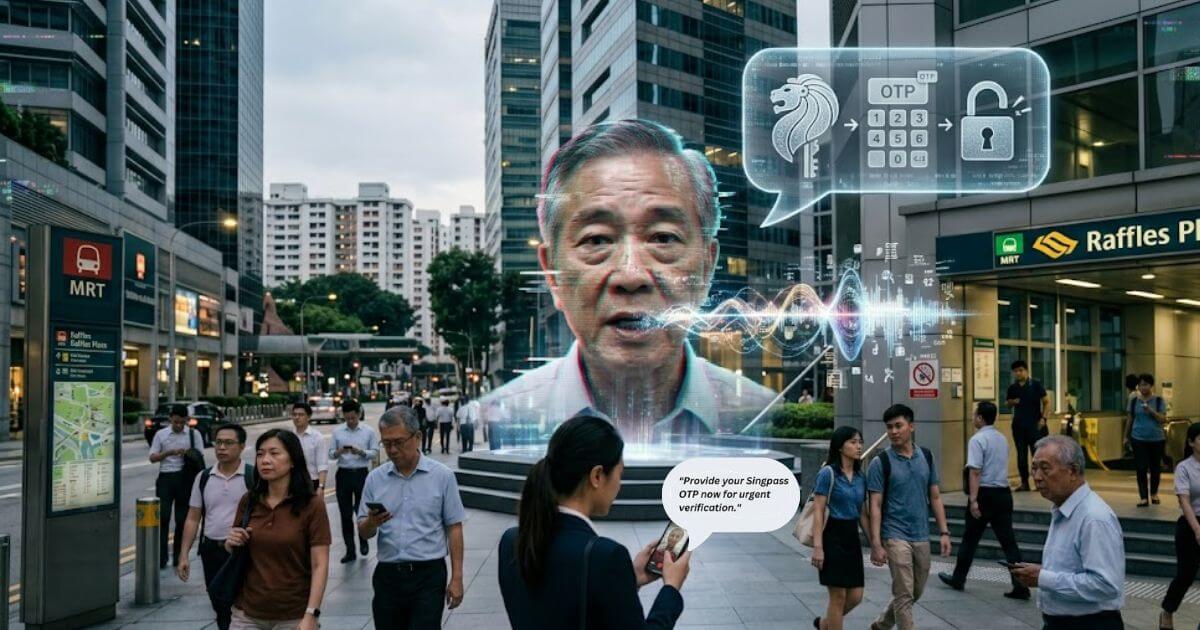
Over the past two years, phishing in Singapore has evolved rapidly. What was once dominated by high‑volume email campaigns has shifted toward targeted, context‑aware attacks designed specifically for enterprise environments. Today’s phishing attacks are frequently AI‑enabled and delivered across multiple channels, including voice calls, collaboration platforms, and even deepfake audio and video.
Key Business-Focused Insights
Insights from the Singapore Cyber Landscape 2024/2025 report highlight several trends that are particularly relevant to businesses:
- Banking and Financial Services were the most spoofed industries, accounting for over 56% of reported phishing cases
- 12% of phishing emails contained AI‑generated content, making them more convincing and harder to detect
- 69% of phishing websites used HTTPS, reducing the effectiveness of traditional trust indicators
These are not consumer‑grade scams. They are deliberately engineered attacks designed to bypass corporate controls by exploiting trust, authority, and routine business workflows.
From Email to Everywhere: How Phishing Has Changed in Singapore
Email remains a common delivery channel, but attackers are no longer dependent on it. Regulators and law‑enforcement agencies in Singapore have observed a steady shift toward multi‑channel social engineering
Common patterns now include:
- Impersonation via Microsoft Teams or Slack
- WhatsApp‑initiated business scams targeting employees directly
- Phone‑based voice phishing (vishing) aimed at IT support and finance teams
- AI‑driven deepfake audio and video, particularly for executive impersonation
CSA and SingCERT have specifically warned about the rise of helpdesk impersonation and phone‑oriented social engineering aimed at resetting credentials, bypassing MFA, and initiating fraudulent fund transfers
Deepfake and Voice Phishing: When "Seeing and Hearing" Is No Longer Believing
One of the most concerning developments in Singapore is the emergence of deepfake enabled phishing attacks targeting enterprises.
Real-World Case: The US$499,000 Deepfake Scam
In March 2025, a finance director at a multinational firm in Singapore authorised a US$499,000 transfer after joining a Zoom call that appeared to include senior executives. In reality, every participant on the call was an AI‑generated deepfake. The fraud was only uncovered when scammers attempted a second transfer, prompting police involvement.
Following this and similar incidents, the Singapore Police Force (SPF), Monetary Authority of Singapore (MAS), and CSA issued a joint advisory warning businesses about scams involving AI‑generated video and voice impersonation of executives. The advisory reinforced a clear message: traditional verification methods are no longer sufficient when attackers can convincingly replicate trusted identities
Why Singapore Businesses Are Prime Targets
Singapore’s business environment creates unique exposure in the face of modern phishing attacks:
- Flat organisational structures enable speed, but reduce independent verification layers
- Regional finance hubs concentrate payment authority in fewer roles
- Heavy reliance on remote communication and cross‑border coordination increases impersonation risk
- A strong culture of trust in digital interaction and leadership communication is routinely exploited
Critical Insight: According to the Singapore Police Force, self‑effected transfers—where employees are manipulated into making legitimate payments—account for more than 80% of scam‑related losses involving businesses. This underlines how effective these attacks have become at influencing real‑world decisions.
Why Awareness Alone Is Not Enough
CSA, MAS, and SPF consistently advise organisations to implement verification workflows, train employees on emerging scam techniques, and confirm urgent requests through secondary channels.
What is often missing is behavioural testing, particularly for:
- Voice‑based phishing
- Deepfake executive impersonation
- Multi‑channel attack chains that span email, chat, and phone
Without realistic testing, employees encounter these scenarios for the first time during a live attack—precisely when pressure is highest.
Why Phishing Simulation Matters More Than Ever in Singapore
Modern phishing simulation is no longer about measuring who clicks a link. It is about:
- Identifying trust based decision failures
- Stress testing verification and escalation paths
- Preparing employees for realistic attack journeys, not theoretical ones
With phishing increasingly involving voice calls and ai-driven synthetic media, simulations must reflect:
- Local business context
- Regional scam scenarios
- Singapore‑specific threat patterns and regulatory expectations
Anything less creates a false sense of preparedness
Final Thought
Phishing in Singapore has changed—not just in scale, but in sophistication, delivery, and impact.
When attackers can convincingly impersonate your leadership, your vendors, or even your regulators, technology alone cannot protect your organisation.
Preparedness now depends on realism. And realism begins with testing.
PhishPrep: Built for Real‑World Threats
PhishPrep is developed by IARM Information Security, a Singapore‑based global cybersecurity company with deep experience in enterprise security, risk management, and regulated environments.
Designed with the realities of modern phishing in mind, PhishPrep reflects strong understanding of:
- Singapore’s enterprise operating landscape
- Local data‑privacy and compliance expectations
- Regional attack patterns across APAC
- The cultural and linguistic diversity of distributed workforces
PhishPrep enables organisations to simulate modern phishing and social‑engineering scenarios in a controlled, realistic manner—preparing employees for the attacks they are most likely to face. With support for multi‑channel simulations, impersonation‑based scenarios, and multilingual delivery, organisations can strengthen resilience without compromising compliance, data residency, or employee privacy.
In a threat landscape that continues to evolve, PhishPrep helps organisations move from awareness to readiness.