

Helpdesk Phishing Attacks: Why IT Support Is the New Frontline in Social Engineering
For years, phishing defence focused on inboxes. Firewalls, email gateways, URL filters, and user training became the backbone of protection.
But attackers adapted.
Today, some of the most damaging breaches don’t start with a malicious email. They start with a phone call to the helpdesk, calm, confident, and entirely believable. Helpdesk phishing has quietly become one of the most targeted entry points in modern cyberattacks, and it’s exposing a gap that email security was never built to cover.
Helpdesk Phishing Statistics: What Recent Data Shows
Recent research from incident‑response teams and threat‑intelligence groups shows how rapidly attackers have shifted focus toward voice‑based social engineering and helpdesk exploitation:
- 51% of organizations now rank helpdesk bypass attacks as their top identity risk, following repeated breaches originating from service‑desk workflows rather than malware or endpoint compromise.
- In voice‑based phishing (vishing) attacks, 30% of fraudulent callers successfully pass helpdesk identity checks, often using real employee data sourced from breaches and OSINT.
- Threat groups like Scattered Spider (UNC3944 / Octo Tempest) consistently target helpdesk workflows to bypass MFA and seize privileged access.
- Incident responders have documented helpdesk‑enabled account takeovers that escalated to full admin access in under 60 minutes.
This isn’t an increase in volume, it’s an increase in precision.
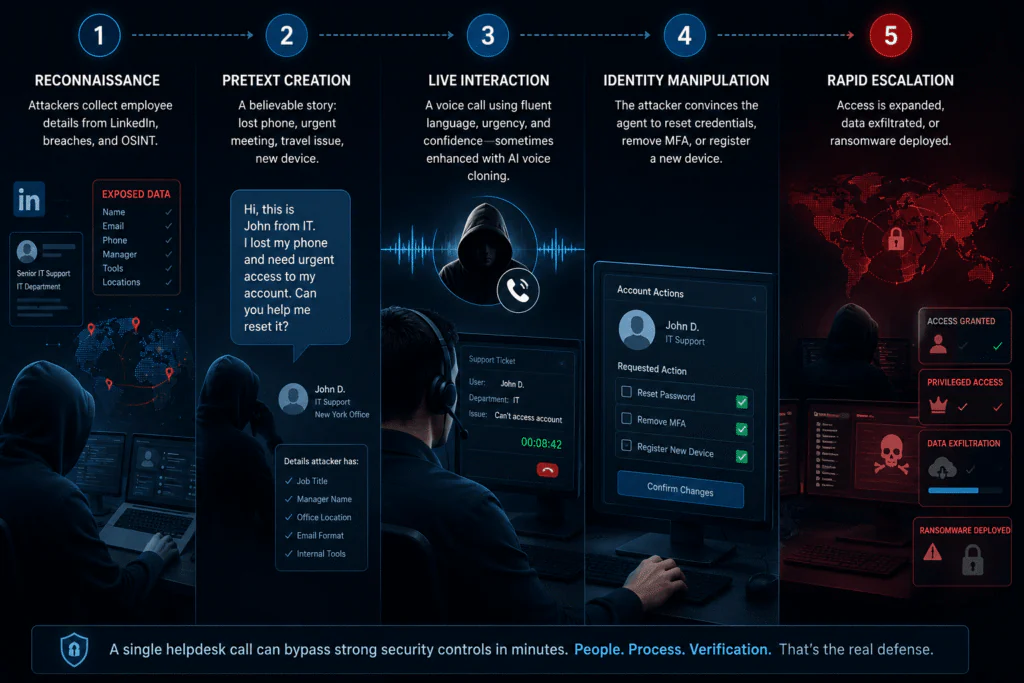
How Attackers Target Helpdesks: The Attack Pattern
Modern helpdesk phishing (often voice‑based) follows a repeatable pattern:
- Reconnaissance, Attackers collect employee details from LinkedIn, breaches, and OSINT: job titles, managers, internal tools.
- Pretext Creation, A believable story: lost phone, urgent meeting, travel issue, new device.
- Live Interaction, A voice call using fluent language, urgency, and confidence, sometimes enhanced with AI voice cloning.
- Identity Manipulation, The attacker convinces the agent to reset credentials, remove MFA, or register a new device.
- Rapid Escalation, Access is expanded, data exfiltrated, or ransomware deployed.
Why Helpdesks Are Such Valuable Targets for Attackers
Helpdesks sit at the intersection of trust, urgency, and authority, exactly where attackers want to operate.
Several structural realities make the risk even higher:
- Helpdesk functions are frequently outsourced to third‑party service providers, expanding the attack surface beyond internal control.
- High attrition rates in helpdesk teams mean new agents are onboarded continuously, often with limited time for deep security training.
- Rotational and follow‑the‑sun shifts create additional pressure: night shifts, regional handoffs, reduced staffing, and agents unfamiliar with specific users or escalation patterns.
- Most helpdesk teams, internal and outsourced, have never been tested with realistic voice phishing or social‑engineering simulations, leaving them unprepared for live attacker interaction.
Threat groups like Scattered Spider (UNC3944 / Octo Tempest) have repeatedly demonstrated how a single successful helpdesk call can collapse even mature identity defences
Real-World Helpdesk Breaches: MGM, Caesars,
M&S, and JLR
Helpdesk‑driven attacks are no longer theoretical. They are causing real operational and financial damage.
- MGM Resorts and Caesars Entertainment suffered extended outages after attackers convinced helpdesk staff to reset credentials and re‑enroll MFA, leading to ransomware deployment and operational disruption.
- Marks & Spencer (2025) experienced significant service outages and market‑value impact after attackers abused IT service‑desk workflows to bypass identity controls.
- Jaguar Land Rover (2023–2024) disclosed a cyber incident involving unauthorized access and service disruption. While full technical details were not publicly released, IR analysis and industry reporting link the broader campaign to credential abuse and social‑engineering‑based access, consistent with modern helpdesk exploitation patterns.
The most damaging part? These attacks bypass the controls organizations trust the most, MFA, EDR, and email security.
Why Traditional Phishing Training Isn’t Enough for Helpdesk Teams
Helpdesk teams are not normal users, yet most organizations train them that way.
Helpdesk staff work under constant time pressure, are measured on resolution speed, and regularly make decisions that alter identity state. A single mistake can affect hundreds or thousands of accounts.
Static awareness training does not prepare an agent for a convincing voice using internal terminology, a multi‑step pretext built over days, or an urgent call placed during a night shift when verification feels like friction. For helpdesks, generic phishing training is insufficient. Testing must be frequent, role‑specific, and multichannel
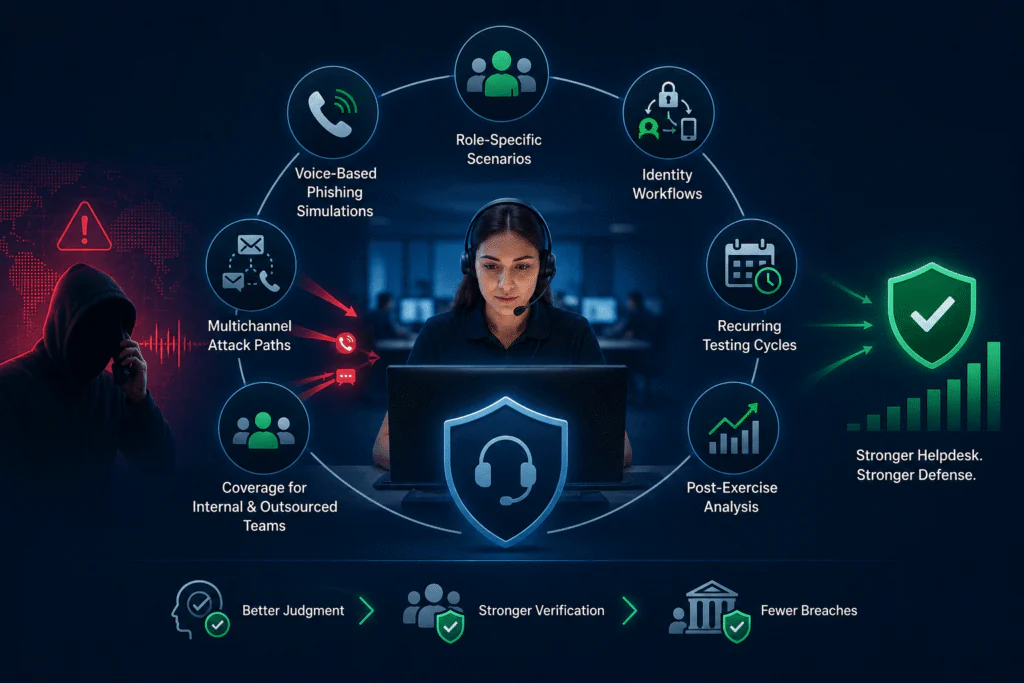
How to Test Your Helpdesk Against Social Engineering
Effective helpdesk testing reinforces judgment under pressure, not trickery. Modern programs should include:
- Voice‑based phishing simulations that reflect how real attackers engage helpdesk teams
- Multichannel attack paths (email → collaboration tools → phone) that mirror real campaigns
- Role‑specific scenarios (IT admin, finance, executive accounts)
- Identity workflows such as password resets, MFA re‑enrollment, and device registration
- Recurring testing cycles, quarterly at minimum; monthly for high‑risk environments
- Coverage for both internal and outsourced helpdesk personnel, using the same standards
- Post‑exercise analysis focused on decision points, escalation quality, and verification discipline
Organizations that actively test helpdesk workflows consistently reduce successful social‑engineering attacks over time.
Key Takeaway
The modern helpdesk has become an identity gatekeeper, often without organizations fully acknowledging the responsibility that comes with that role. Attackers understand this reality and exploit fatigue, staffing gaps, trust, and urgency with precision.
Email security and MFA alone are no longer sufficient when the attack surface includes human workflows designed for speed and service. Whether your helpdesk is internal or outsourced, preparedness depends on how realistically, and how often, those teams are tested.
Organizations that treat helpdesk security as a continuous risk‑management function will prevent incidents; those that do not will eventually investigate one.
References
- Palo Alto Networks Unit 42 – Global Incident Response Report: Social Engineering Edition, unit42.paloaltonetworks.com
- MITRE ATT&CK – Scattered Spider (G1015), attack.mitre.org
- RSA – ID IQ Report 2026, rsa.com
- Huntress – Phishing Attacks Targeting Businesses, huntress.com
- Mutare – State of Vishing Report 2024, mutare.com
Test Your Helpdesk Against Phishing Attacks, PhishPrep
PhishPrep helps organizations move beyond generic phishing tests by delivering voice‑based phishing simulations, multi‑channel attack scenarios, and helpdesk‑specific templates designed to test identity‑critical workflows like MFA resets and account recovery.
With multilingual support, knowledge‑nugget micro‑training, and the ability to test helpdesk teams across global locations and outsourced partners, PhishPrep enables consistent, realistic testing where it matters most. Contact us to see how PhishPrep can test your helpdesk against real‑world social engineering attacks.