
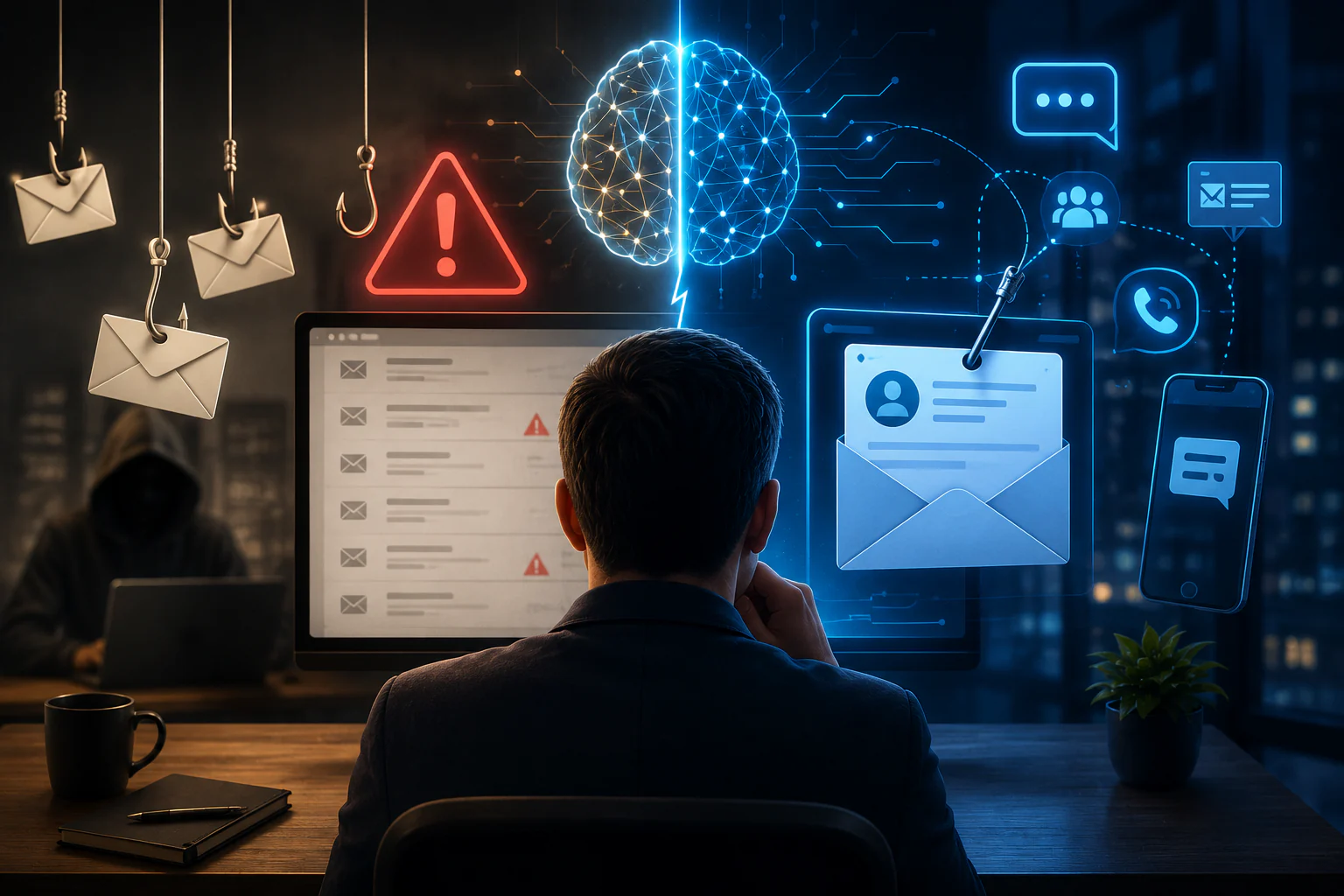
For a long time, phishing simulation followed a familiar playbook.
Run periodic email tests, track click rates, roll out security awareness training, and report improvement.
This traditional phishing simulation model became widely accepted because it worked, at the time.
But today, AI has fundamentally changed how phishing works. And most phishing simulation programs simply haven’t evolved at the same pace. What once reduced risk is now giving many organizations a false sense of security.
The gap between how we test humans through phishing simulations and how humans are attacked is growing, and that gap is where breaches happen.
The Threat Model Has Shifted – But Our Phishing Testing Hasn’t
Modern phishing attacks are no longer mass-produced. They’re contextual. They reference real projects, real teams, and real business workflows. They don’t rely on broken grammar or suspicious formatting. In fact, many are indistinguishable from routine business communication.
The results are alarming:
- AI-generated phishing emails are now 4x more likely to deceive recipients due to flawless language and deep personalization.
- AI-driven phishing volume has surged 1,265% since 2022.
- 60% of organizations surveyed reported cyberattacks spreading beyond email into platforms such as Teams, Slack, and SMS.
This isn’t theoretical risk. This is happening right now, and phishing simulation solution must evolve to reflect these modern attack techniques.
Why Familiar Phishing Simulations Stop Teaching Anything
One of the biggest problems with traditional phishing simulations isn’t technology, it’s predictability. Employees start to recognize the timing, the style, and the tone.
They don’t get better at spotting phishing. They get better at spotting the phishing simulation.
Real attackers don’t use predictable schedules. They don’t reuse templates. And they don’t limit themselves to a single channel.
Effective phishing attack simulation must test how employees respond to realistic, contextual, and unpredictable threats.
Email Is No Longer the Center of Phishing Simulation
Modern phishing rarely stays in one place.
A typical attack might start with an email, move to Teams or Slack, follow up with SMS, and end with a voice call.
Yet many email phishing simulation programs still stop at email, testing the channel employees are already trained to scrutinize, while ignoring environments where trust is highest and suspicion is lowest.
Modern phishing simulation tools need to consider multichannel phishing attacks and how employees make security decisions across different communication platforms
What Needs to Change in Phishing Simulation
Phishing simulation needs a mindset shift to remain effective:
- From email-only phishing testing to multichannel phishing simulation realism.
- From static templates to context-driven phishing scenarios.
- From compliance exercises to human risk discovery.
- From click rates to employee decision-making analysis.
- From single phishing simulation campaigns to end-to-end attack journeys.
The objective of modern phishing simulation and security awareness training is no longer to prove awareness exists, but to reveal where trust fails under realistic pressure.
Final Thought
Traditional phishing simulation isn’t obsolete. But on its own, it’s no longer sufficient.
AI has removed many of the warning signs people were trained to recognize. It has blurred the lines between legitimate communication and deception. And it has raised the bar for what realistic phishing simulation testing must look like.
If phishing simulations don’t feel ambiguous, uncomfortable, and realistic, then they’re likely not preparing anyone for the attacks that matter most.