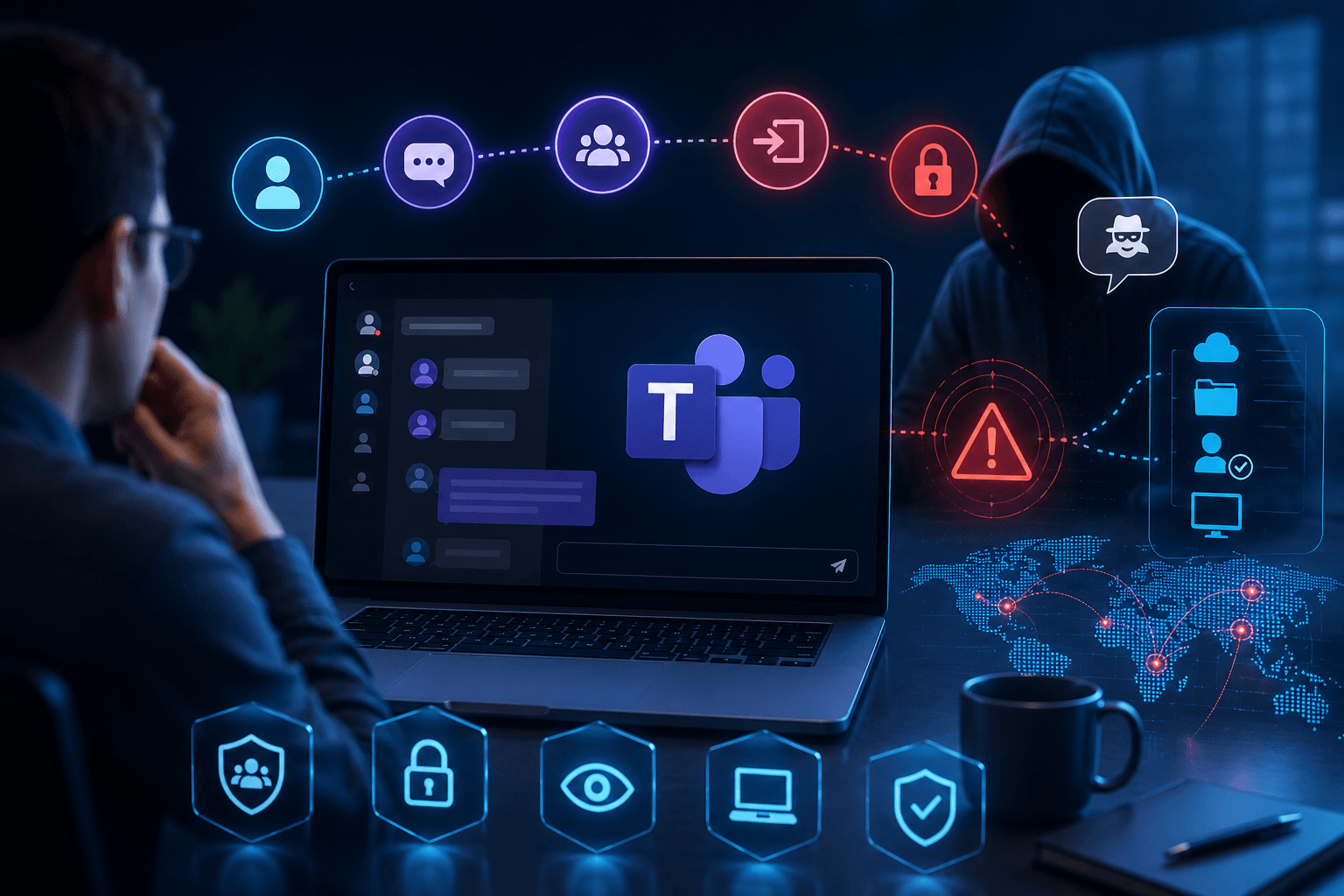
Customer Data Theft
Phishing campaigns designed to gain access to customer records, business systems and cloud environments.
Simulate with emailAttackers now target developers, engineers and IT teams rather than the code. Prepare them for phishing, Teams messages, helpdesk impersonation, deepfakes and AI-generated social engineering.
Technology organizations adopt cloud, collaboration platforms and hybrid work early. Attackers follow. PhishPrep lets you simulate each attack safely.
Phishing campaigns designed to gain access to customer records, business systems and cloud environments.
Simulate with emailAttacks targeting developers, administrators, support staff and privileged users.
Simulate with emailSocial engineering campaigns delivered through trusted collaboration environments.
Simulate on TeamsAttackers posing as internal support personnel to obtain credentials and reset MFA controls.
Simulate on TeamsAdvanced phishing generated using artificial intelligence, deepfakes and voice cloning.
Simulate a deepfakeExecutive fraud scenarios and authority-based social engineering attacks.
Simulate with emailPhishPrep prepares employees for AI-powered phishing while providing measurable security awareness outcomes.
Customize existing templates or create simulations tailored to internal applications, workflows and development processes.
AI-era awareness
Campaign library
Search6 ready-made scenarios
Report phishSecurity awareness for distributed technology teams
Most technology organizations operate across offices, remote environments and global development teams.
Developers, architects, DevOps engineers and platform teams.
Infrastructure, support and system administration personnel.
Employees responsible for delivering customer-facing services.
Personnel frequently targeted through impersonation and social engineering attacks.
High-value users often targeted by sophisticated phishing campaigns.
Technology compliance & phishing risk insights
Prove that awareness initiatives improve behavior and reduce organizational risk, and turn simulation results into actionable security intelligence.
Supports organizations aligning with
 SOC 2
SOC 2 ISO/IEC 27001
 NIST Cybersecurity Framework
Gain visibility into
SampleFlexible deployment for technology organizations
Quick deployment with minimal administration.
Best for fast rollout with minimal administration
Dedicated infrastructure for organizations requiring stronger separation.
Best for stronger separation without managing servers
Explore this deploymentComplete infrastructure and data control.
Best for full infrastructure and data control
Explore this deploymentSupport highly secure development and operational environments.
Best for isolated development and operational networks
Explore this deploymentDeploy directly into your AWS environment with full ownership and visibility.
Best for AWS-native engineering organizations
Explore this deploymentTechnology organizations release continuously and adopt new tools fast. Annual training can't keep up. PhishPrep's PACT methodology turns awareness from a compliance exercise into a continuous program that reduces human risk.
Awareness that keeps pace with rapidly evolving social engineering techniques.
Awareness and simulations for the tools distributed teams actually use.
Measurable reduction in human risk over time.
Find quick answers, or talk to our team.
Talk to a Security Awareness SpecialistYes. PhishPrep supports software product companies, SaaS providers, IT services firms, and technology startups.
Yes. Organizations can simulate phishing attacks delivered through Microsoft Teams and other collaboration platforms.
Yes. Existing templates can be customized, and completely new scenarios can be created to reflect internal workflows and technologies.
Yes. Organizations can train employees against AI-generated phishing attacks, deepfakes, voice cloning, and social engineering campaigns.
Yes. PhishPrep provides reporting and metrics aligned with frameworks such as SOC 2, ISO 27001, NIST, GDPR, Cyber Essentials, and EU CRA initiatives.
Strengthen employee resilience against phishing, deepfake, voice fraud and AI-powered social engineering attacks with realistic simulations and measurable security outcomes.